 위린이
위린이
The name on Dewar’s Double Double 21 Years spells out the process: blended twice, aged twice, across four stages. The nose hits the second you pour, and the 21-year age carries real complexity without a sharp edge anywhere.
Dewar’s and the Double Double story
- Dewar’s: founded 1846. Aberfeldy in the Highlands is the heart distillery - that honey-forward character is what the blend is built around
- Double Double: a four-stage process developed by master blender Stephanie Macleod. Blended twice, aged twice
The four stages go like this: malt and grain age separately, then get blended and “married” for a stretch so the spirits settle together, then aged a second time, and finally finished in select casks. Most blends just mix spirits and bottle them, so this is a different approach - and what lands in the glass backs up the intent.
Dewar’s core lineup
The range splits between the standard line and the Double Double series.
| Product | ABV | Character |
|---|---|---|
| White Label | 40% | Popular highball base, mass-market line |
| 12 Years | 40% | Marriage-aged, strong value |
| 15 / 18 Years | 40% | Deeper sherry dried-fruit expressions |
| Double Double 21 Years | 46% | Four-stage aging, today’s bottle |
| Double Double 27 / 32 Years | 46% | Long-aged premium on the same process |
Tasting notes
What does that four-stage process actually look like in the glass.
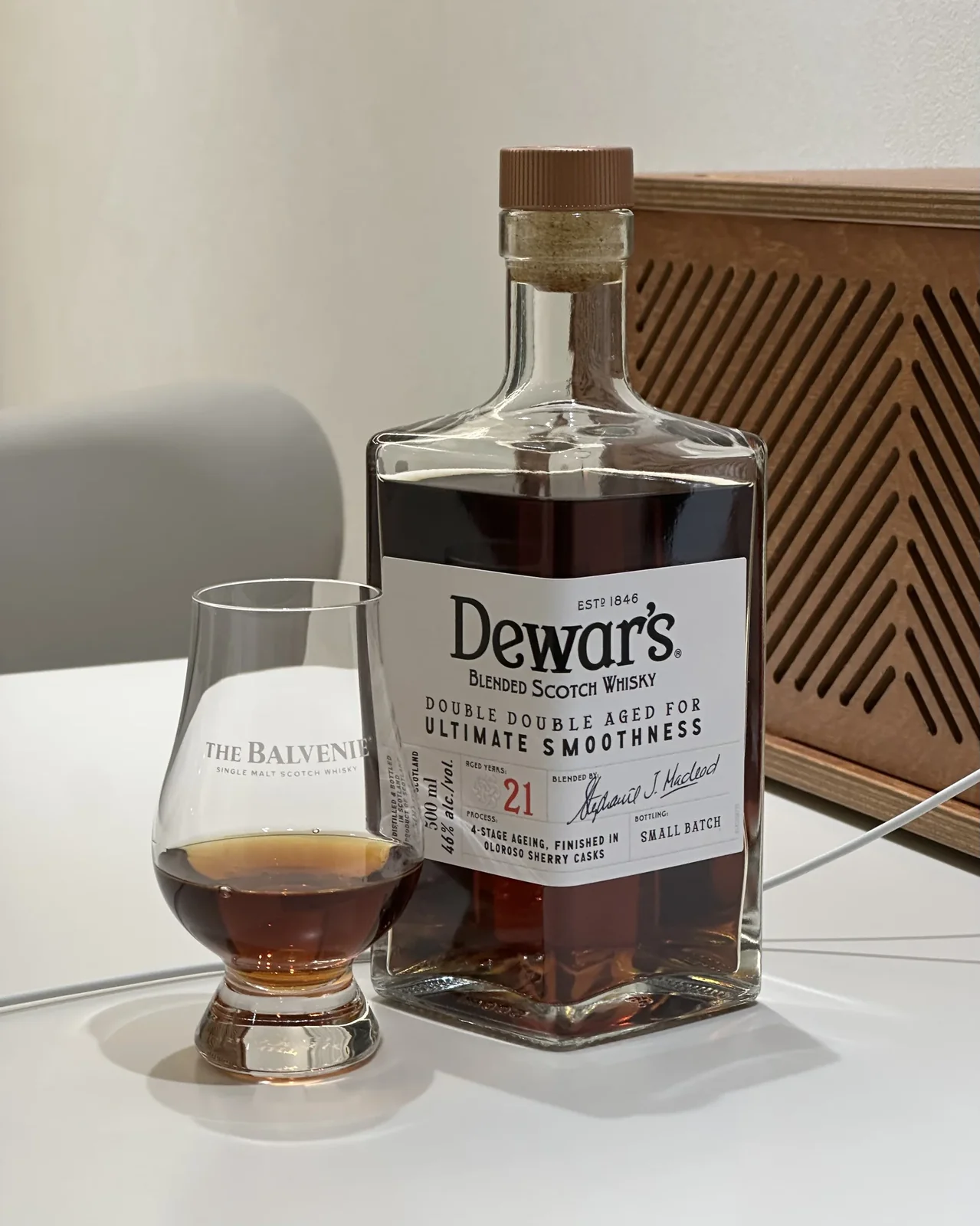
Nose
Lean in and it’s dominated by sweet sherry. A little vanilla and oak sit on top, then concentrated dried fruit - something like ripe black cherry - follows through. Both pear and apple come up, pear a touch stronger, and it’s more the low-acid sweet side of fruit than the bright citrus zone. There’s some alcohol push, but very faint. The sherry is intense enough that there’s a sulfur-adjacent nuance floating around, but nothing off-putting. Not straight honey - more like honey water, gentle sweetness. A nose that shows its 21 years.
Palate
First sip is straight-up sherry sweetness filling the mouth. About three seconds in, a soft spice lifts - nothing aggressive, background-level. The pear and cherry from the nose show up faintly. Medium body. Tannin is almost absent. It skews sweet overall.
The smooth, rounded texture is the whole point of this bottle. No corners anywhere. Every flavor melts together so the whole thing rolls across the palate as one piece. That seamless cohesion is where blended whisky earns its keep, and single malts don’t usually deliver it this cleanly. On Double Double 21 it’s dialed all the way up. Blind, you’d struggle to peg this as a blend.
Finish
A pleasant smokiness lifts gently. Maybe 1% peat. Sherry sweetness holds a little at the tail. Length is average, but the presence is clear without ever being loud.
Food pairings
- Aged cheddar - the 21-year complexity pairs with the deep savory side of aged cheese
- Smoked salmon canape - the soft body from the four-stage aging lines up with smoked salmon
Bottom line
My blind spot around blended whisky shifted quite a bit after this one. The time and work that went into the four-stage process shows in the glass.
The positioning against 21-year single malts is actually reasonable. Not cheap, obviously, but for a 21-year whisky at this level of execution, the tag feels fair. On the premium blended side, Royal Salute 21 Years is another one to hold up alongside this - different approach though. If you live in single malt territory, it’s worth a side trip over here.
Neat is where this shines. A couple drops of water let the honey note open a little more. Highball is a no from me. Diluting a 21-year whisky at this price with soda feels like a waste.
Looking for something with a different profile in the Dewar’s lineup, Dewar’s 18 Mizunara Cask Finish is another interesting comparison. Double Double 21 is structured complexity; the 18 Mizunara leans on 40% ABV softness.
![[Bourbon] Knob Creek vs Russell's Single Barrel](/assets/images/posts/2026-04-26-knob-creek-9-vs-russells-reserve-single-barrel-comparison.webp)
![[Highland] Glenmorangie Infinita 18 First Pour Review](/assets/images/posts/2026-04-24-glenmorangie-the-infinita-18-years-review.webp)
![[Sherry] Macallan 12 vs GlenDronach 12 - Side by Side](/assets/images/posts/2026-04-20-macallan-12-vs-glendronach-12-sherry-comparison.webp)