 위린이
위린이
The first Japanese whisky I tried after years of only drinking Scotch arrived as a gift from a friend, and it caught me off guard. My first thought was just how did Japan pull this off - the level was that high. That first pour happened to be Nikka Taketsuru Pure Malt. Clearly different from Scotch, but you can feel the roots tying back, with a clean, restrained Japanese signature layered on top. An unusual whisky.
The distillery
- Founder: Masataka Taketsuru. Learned whisky-making in Scotland in 1918, co-founded Yamazaki under Suntory, then struck out on his own
- Distilleries: Yoichi in Hokkaido, 1934 (heavy, peated) + Miyagikyo, 1969 (light, elegant). Blending spirit from both distilleries is what Taketsuru Pure Malt is
- Current status: the Japanese whisky boom cratered supply. 12, 17, and 21 Year-Old expressions all discontinued. Only the NAS version is left
Where this bottle comes from
“Pure Malt” is the old wording for what we now call “blended malt.” Yoichi’s peaty, muscular spirit gets married to Miyagikyo’s fruity side.
I wouldn’t write the NAS version off as a lesser bottle. With the age statement gone, the blenders have more room to dial the ratio, and for what this whisky is, there’s still plenty worth saying.
Nikka core lineup
Nikka splits cleanly between the two distilleries’ single malts and the blended range.
| Product | Category | ABV | Character |
|---|---|---|---|
| Taketsuru Pure Malt | Blended malt | 43% | Yoichi + Miyagikyo, today’s bottle |
| From The Barrel | Blended | 51.4% | Near cask-strength value legend |
| Yoichi Single Malt | Single malt | 45% | Coal-fired distillation, peated, heavy |
| Miyagikyo Single Malt | Single malt | 45% | Light, fruity |
| Coffey Grain / Coffey Malt | Grain / malt | 45% | Coffey still distillation, sweetness that leans toward bourbon |
Tasting notes
Where Yoichi and Miyagikyo meet in the glass.
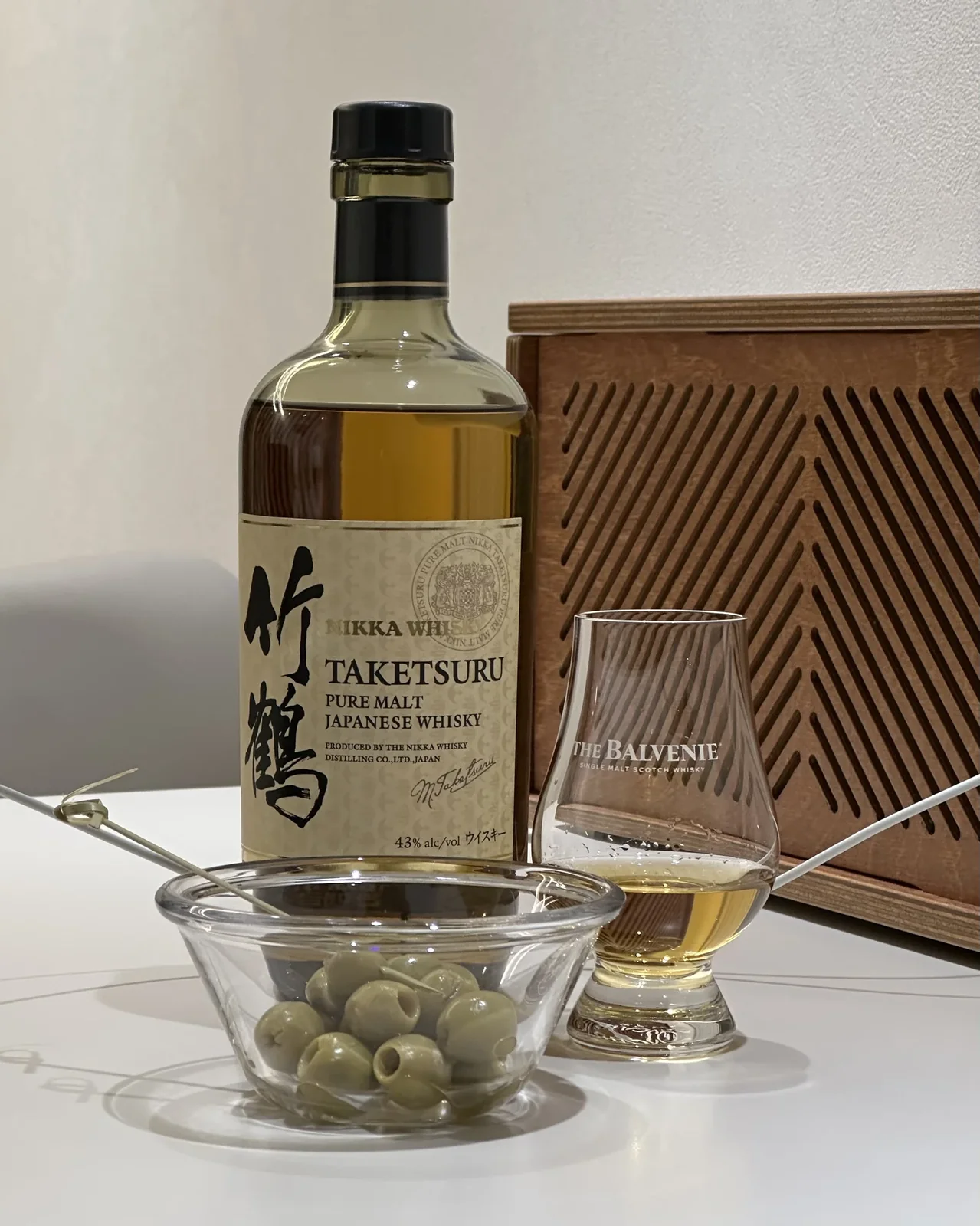
Nose
Apple. Not green apple - ripe Fuji apple, closer to that. Citrus brightness and honey sweetness weave in, and the first impression is bright. Soft vanilla cream underneath. A faint floral lift brushes the nose too. Then there’s the trace of smoke, probably from the Yoichi side, sitting way in the background. You’d miss it if you weren’t looking. Clean, clear - that cleanness is the Japanese-whisky signature.
Palate
Smooth. The texture spreads evenly across the palate, then orchard fruit - apple, pear - comes up. Toffee sweetness slots into the middle, and a mild peat smoke makes a quiet appearance. White pepper adds a subtle spice that plays off the sweetness, and clean malt character runs through the whole thing.
The pull of Taketsuru Pure Malt is in that balance. Nothing spikes - smoke stays light, sweetness stops short of cloying, and the spice never nags. That’s the biggest break from Scotch. Where something like Macallan 12 Sherry Oak leads with the strong character of sherry cask, Taketsuru leans on harmony and restraint.
Finish
Medium. Cleaner finish than you’d expect. Gentle smoke lingers faintly, fruit sweetness hangs around. A touch of bitter chocolate shows up at the very tail, but it’s so controlled it never turns unpleasant. Actually, that bitterness is what keeps the finish from going flat. Not a long Lagavulin-style finish, but clean off, with the tail still holding on.
Food pairings
- Yakitori (grilled chicken skewers) - Japanese whisky with soy-glazed skewers is a classic pairing on home ground
- Sashimi - the clean finish on Taketsuru lets the delicate fish character come forward
If you’re curious what Japanese whisky is, Taketsuru Pure Malt is a sensible first stop. If Hibiki sets the bar on the blended side, Taketsuru carries the malt side.
The NAS thing is the one thing I’d ding it for. People who drank the old 17 or 21 might feel the drop. Still - at this tier, finding a Japanese whisky of this quality isn’t easy. Neat is the default. Mizuwari (1:1 to 1:2 with water) actually opens the delicate notes more. Highball works too.
![[Bourbon] Knob Creek vs Russell's Single Barrel](/assets/images/posts/2026-04-26-knob-creek-9-vs-russells-reserve-single-barrel-comparison.webp)
![[Highland] Glenmorangie Infinita 18 First Pour Review](/assets/images/posts/2026-04-24-glenmorangie-the-infinita-18-years-review.webp)
![[Sherry] Macallan 12 vs GlenDronach 12 - Side by Side](/assets/images/posts/2026-04-20-macallan-12-vs-glendronach-12-sherry-comparison.webp)