 위린이
위린이
Two bottles two months into their openings, similar levels in the glass, both cask strength, both first-fill oloroso. Should have read close to each other. They didn’t. Once I put Arran Sherry Cask next to Aberlour A’bunadh Batch 84 and bounced between the glasses, the gap turned out wide enough to make me almost embarrassed I’d lined them up as a fair fight.
Why these two
Cask-strength oloroso single malts are a small enough club that the names repeat: GlenAllachie 10 Cask Strength, A’bunadh, and Arran Sherry Cask a step back from the headliners. All three share the basic build - full maturation in oloroso, no chill filtration, no added color, bottled at natural strength. On paper they’re cousins.
- Arran Sherry Cask “The Bodega”: first-fill oloroso sherry hogsheads, full maturation, 55.8%
- Aberlour A’bunadh Batch 84: first-fill oloroso sherry butts, full maturation, 61.2%
Different cask format (hogshead vs butt) and a 5.4-point ABV gap, but the broad category is the same.
Arran vs A’bunadh 84 - the quick table
| Arran Sherry Cask | A’bunadh Batch 84 | |
|---|---|---|
| Cask | First-fill oloroso hogshead | First-fill oloroso butt |
| ABV | 55.8% | 61.2% |
| Nose direction | Light sherry, hallabong citrus, faint sulphur | Citrus, light sweet orange |
| Palate direction | One-note sweetness, limited depth | Spice into building sweetness, thick body |
| Finish | Carries the nose forward, light dark chocolate | Heavy, dense oak, layered |
| Body | Light and tidy | Thick, viscous |
On paper, 5.4 ABV points. In the glass, the weight difference reads bigger than that.
Side by side - nose
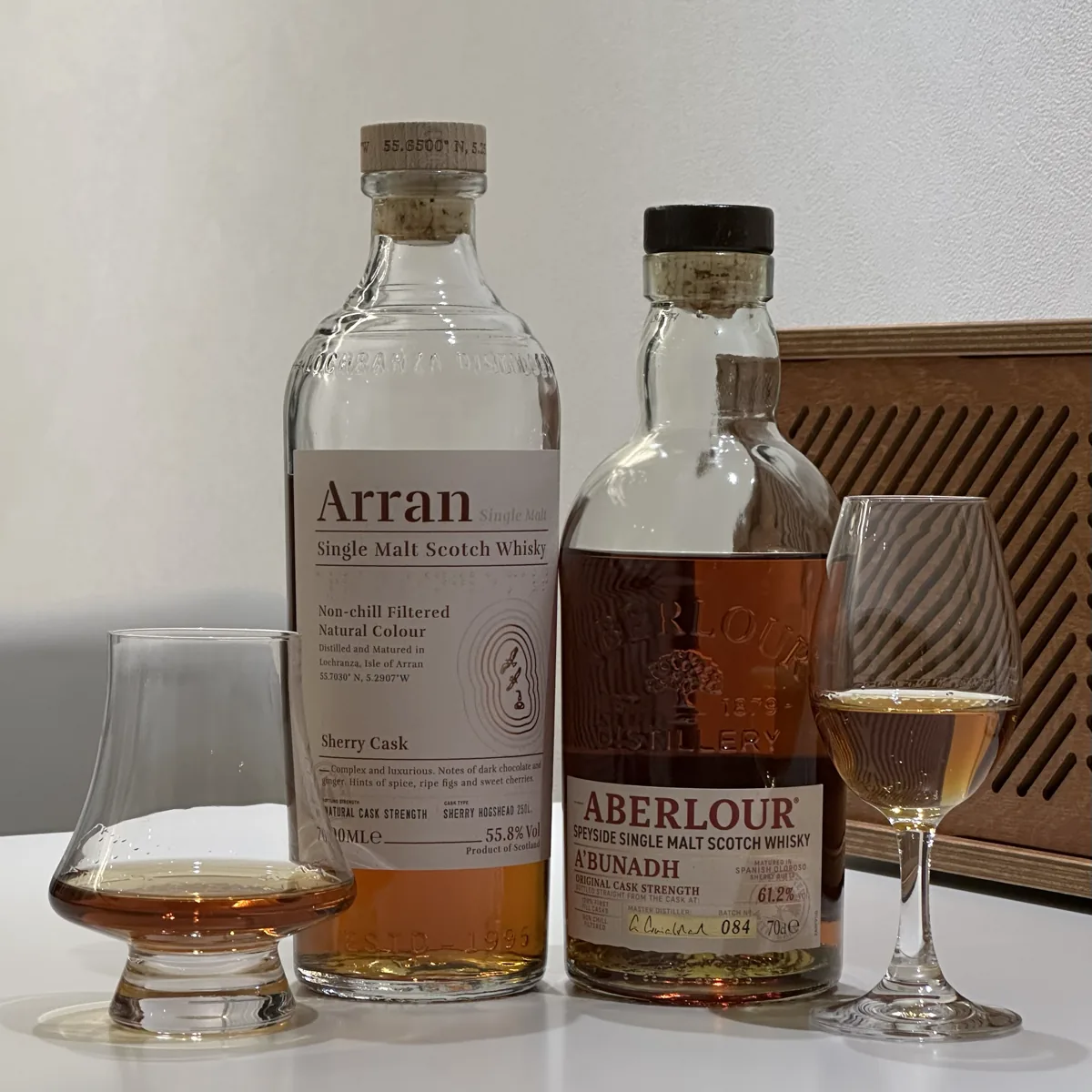
Arran first. The sherry doesn’t sit heavy. It floats. Above that floats a layer of bright citrus that reads closer to hallabong than orange to my nose - sharper, slightly bittersweet, a little less round than common orange peel. There’s also a faint sulphur thread underneath, the kind of edge that nudges the whole profile half a step off-center.
Switch glasses. A’bunadh runs different from the first sniff. Same broad citrus family, but here the citrus is rounder - light, sweet orange right up front. No sulphur, no dark sherry weight on the nose. The bottle with 5.4 more proof points actually opens cleaner. That was the first surprise.
So nose-only: Arran is hallabong-leaning, A’bunadh is sweet-orange-leaning. Same category, very different opening read.
Side by side - palate
This is where the gap starts to widen.
A sip of Arran hits with sherry sweetness right away, and that’s almost the whole story. Roll it on the tongue and not much more arrives. The faint sulphur from the nose follows through and slightly bends the sweetness sideways - not unpleasant, just a touch awkward. A one-line whisky on the palate.
Move to A’bunadh and the information density jumps. Spice taps the tongue first, then the sweetness starts climbing - not dumped in all at once, but building in proportion to how long you hold the spirit in the mouth. A viscous body wraps around the tongue and stretches the sip out. By the time you swallow it doesn’t feel like the moment ended yet.
Side by side, the shape reads pretty cleanly: one-note sweetness on the Arran versus a sweetness that builds on the A’bunadh.
Side by side - finish
This is where the gap is widest.
Arran’s finish just extends its nose. The hallabong line carries through, and a thin streak of dark chocolate shows up at the tail end. Light landing, no fuss - but the nose, palate, and finish wear roughly the same face all the way through. Not much in the way of dimensional shift.
A’bunadh’s finish reads like a different whisky from its own nose. Where the nose was light orange, the finish has heavy oak right in the middle. Dense wood and baking spice stretch out, with a layer of complex aromatics riding on top. Beginning, middle, and end of a single sip each show a different face. This is what you get from oloroso cask whisky when the wood comes forward properly.
Holding them side by side, the finish length on the A’bunadh runs close to twice what the Arran does, and it carries more weight while it stays.
Take price off, put it back on
Complexity, body, finish - A’bunadh wins all three axes. The 5.4 extra proof points sound like they’d be harder to drink, but the proof here translates directly into body, so the trade-off felt like net upside rather than a tax.
Even if you set price aside, A’bunadh is the more interesting glass. Once you put price back in, the gap shrinks somewhat - A’bunadh costs more - but the difference in what arrives per sip more than carried the premium for me. If you specifically want a clean, one-note sherry style at a lower spend, GlenDronach 12 is doing that more cleanly at a step below the Arran’s price point. The Arran ends up in an awkward middle.
The light sulphur thread is going to be a coin flip on taste. If you actively enjoy that note, it’s a feature, not a bug. The sulphur in Glenfarclas 15 is more integrated and reads more controlled by comparison. The common patterns across the sherry cask family in general I broke out in sherry cask common tasting notes.
Wrap-up
Same category on paper, different drinks in the glass. A’bunadh Batch 84 stretches a single sip across three phases and carries it on a body that justifies the higher proof. Arran Sherry Cask leans on one clean sweet note and stays there. For a closer-matched comparison inside the A’bunadh series itself, Batch 82 is the more interesting head-to-head than reaching across to Arran.
![[Sherry & Light Peat] Benromach 15 Years Review](/assets/images/posts/2026-05-19-benromach-15-years-review.webp)
![[Korea] KI ONE Tiger Korean Single Malt Review](/assets/images/posts/2026-05-17-kiwon-tiger-korean-single-malt-review.webp)
![[Cocktail] Camus VSOP + Disaronno French Connection](/assets/images/posts/2026-05-14-camus-vsop-disaronno-french-connection-cocktail.webp)