 위린이
위린이
The Nectar bottle was down to maybe two finger-widths when the Infinita arrived. One had been a near-daily pour long enough that I knew where the nose was going before I got there. The other was a fresh pour from a just-opened bottle. I didn’t sit down to do a head-to-head, but once both glasses landed on the table the gap between them was loud enough that I started taking notes.
The two also sit further apart on retail than I’d realised. Same upper shelf of the Glenmorangie lineup, but the Infinita carries a meaningful step up over the Nectar.
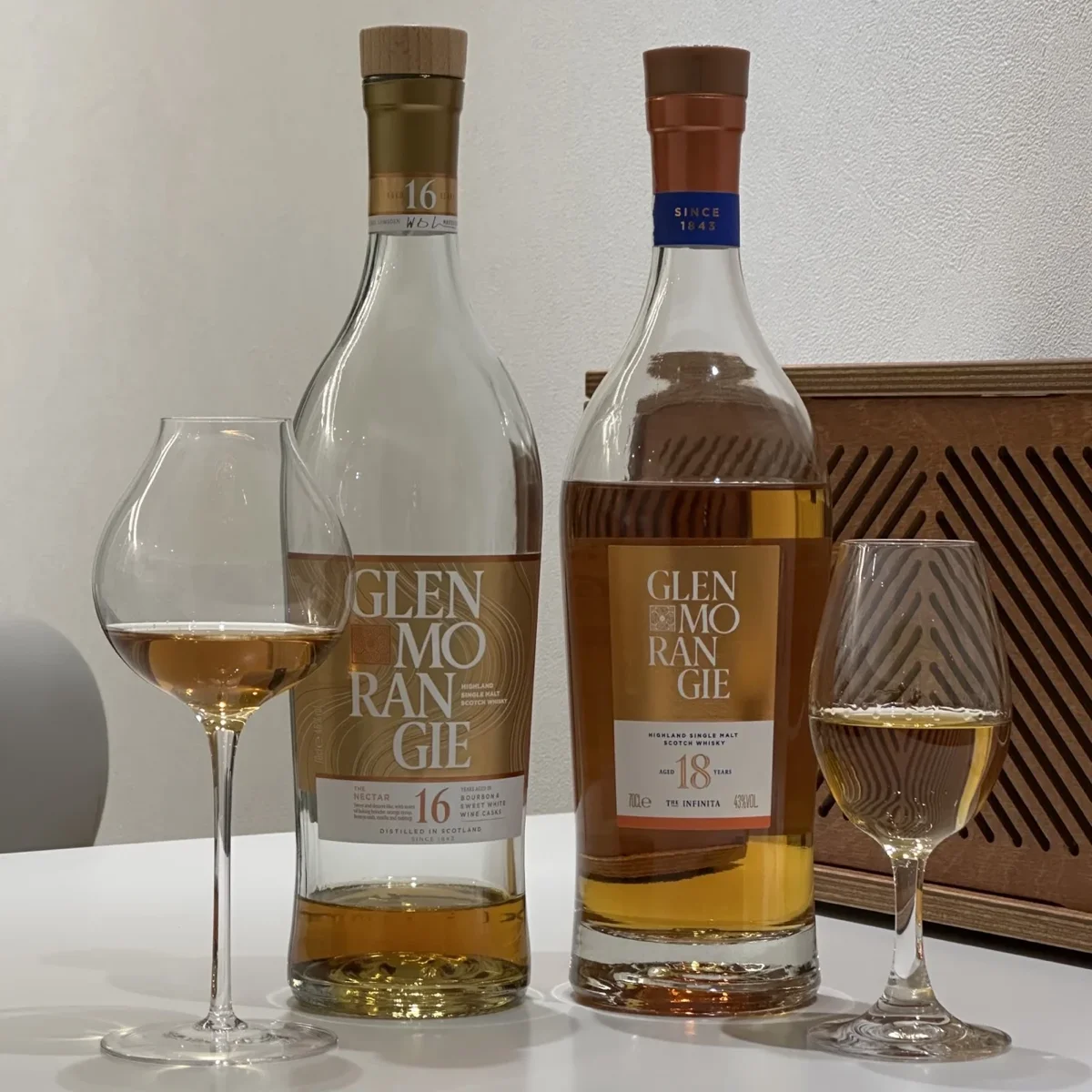
Same starting point, different forks
Both bottles come off the same tall stills at Glenmorangie. The fact that those stills sit among the tallest in Scotland is something I already touched on in the Nectar standalone review, and you can taste that shared base when the two glasses sit next to each other. Clean, light Highland tone underneath both.
The fork is the cask. Nectar spends 14 years in bourbon, then gets two extra years across four sweet white wine casks (Sauternes, Monbazillac, Moscatel, Tokaji). The whole batch goes into dessert wine territory. Infinita spends 15 years in bourbon, then pulls 30% of the liquid into oloroso sherry casks for another 3 years before recombining at a 70:30 ratio.
Same source, but one says “let’s coat the whole thing with four dessert wines,” and the other says “let’s add a touch of dry sherry to balance it out.” The two glasses end up pointing in different directions because of that.
The Nectar 16 Years - brightness as the base
First thing on the nose is malt. Fig sits on top of that, then floral notes and herbs, with a faint orange peel at the tail. It’s a wine-finished whisky that doesn’t push sweetness to the front. The grain note runs the show, and that’s what gives this one its character to me.
On the palate, malt and honey water lead, a small spice run passes through, and dried fruit shows up behind that. Not a full sherry-bomb thickness, but a thin sherry-adjacent ribbon does come through. I’d guess that’s the gradient those four wine casks build together.
The finish is where this whisky earns its keep. Malt stays as the floor, and a layered floral-fruit bouquet hangs around for a long time. Pour a glass on a weeknight, set it down, and let it ride - this one is built for that.
Take another sip and what stays with you is brightness and fruit. Fig sets a firm sweet base, and ripe stone-fruit tones - apricot, in particular - take turns with a soft citrus lift on top. It reads like a fruit basket on top of a flowering field. Whatever those four white wine casks pull from the spirit, the thread runs through nose, palate, and finish without breaking. As a beginner I’d happily hand someone this glass if they asked what a fruity whisky is supposed to taste like.
The Infinita 18 Years - the body whisky
The nose was tidier than I expected. Orange peel sits up front, herbs underneath. A lot of people describe this whisky’s nose as deeply complex, but with my beginner’s nose it didn’t open up that wide for me. There’s depth, but the lateral spread on the nose isn’t huge.
Things shift on the palate. A faint smoke runs underneath, and malt and nut tones fan out across it. Same impression I had during the Infinita standalone review - the longer you hold it in the mouth, the more layers separate.
Dried fruit and a quiet sherry note come up on the finish, with wood and a thread of soft smoke trailing. So that’s what 30% sherry inclusion looks like in this house. If you walk in expecting a sherry bomb, this one will read off-target. It pulls a thread from the dry-sherry side of common sherry cask tasting notes rather than the rich PX side.
In a line: less brightness than the Nectar, but with an extra layer of creamy sweetness and smoke. Same Glenmorangie base, pulled heavier and darker.
ABV and body run in opposite directions
Switching between the two glasses, one thing kept feeling backwards. Nectar is at 46%, Infinita at 43% - so Nectar is the higher-proof one. Usually higher ABV means a heavier mouthfeel. Here it goes the other way. Infinita sits heavier on the tongue. Nectar moves lighter.
Thinking about it, the cask split is doing the work. Nectar takes the full batch through four dessert wine casks - that lifts the aromatics and brightness, but it doesn’t add weight. Infinita has 18 years of time plus that 30% oloroso slice loading texture into the body. I’m a beginner so I can’t claim to know the exact mechanism, but the difference in the mouth was clear.
I got the same read in the Macallan 12 vs GlenDronach 12 comparison - cask makeup leans on body more directly than ABV does, at least to my palate.
Setting price aside
On complexity alone, Infinita edges out by a hair. There’s an extra layer that opens up when you roll it on the tongue. 18 years plus the 30% sherry slice earned that.
But even price-aside, the Nectar matched my taste better. The brightness and the long finish hit closer to what I want from a glass. Infinita might be the technically better-built whisky, but over an hour of slow sipping the glass I kept reaching for was Nectar.
Value isn’t even close. Whether the Infinita justifies the premium over the Nectar - it didn’t, not for me. That gap is basically another bottle of Nectar back in the cabinet.
Wrap-up
When the Nectar runs out, odds are I’ll just buy another Nectar. Infinita I’ll keep slow-sipping. Both are good whiskies, just good in different directions. For someone stepping into the Glenmorangie upper shelf for the first time, the Nectar feels like the safer landing point.
![[Sherry & Light Peat] Benromach 15 Years Review](/assets/images/posts/2026-05-19-benromach-15-years-review.webp)
![[Korea] KI ONE Tiger Korean Single Malt Review](/assets/images/posts/2026-05-17-kiwon-tiger-korean-single-malt-review.webp)
![[Cocktail] Camus VSOP + Disaronno French Connection](/assets/images/posts/2026-05-14-camus-vsop-disaronno-french-connection-cocktail.webp)