 Spemer
I’d tasted Russell’s Single Barrel and Rare Breed blind once with friends and couldn’t really tell them apart. Both from Wild Turkey, both high proof, similar weight. The labels just got in my head when I tried to call which was which. I left that night noting I should sit down with all three side by side sometime. This is that follow-up, except labels visible this time.
Russell’s Reserve Single Barrel is 110 proof (55% ABV), non-chill-filtered, picked one barrel at a time by Eddie Russell. Wild Turkey Rare Breed is 116.8 proof (58.4%), non-chill-filtered, a blend of 6-, 8-, and 12-year-old stocks at barrel proof. Both bottles had been open long enough that the noses were fully opened up by the time I poured them.
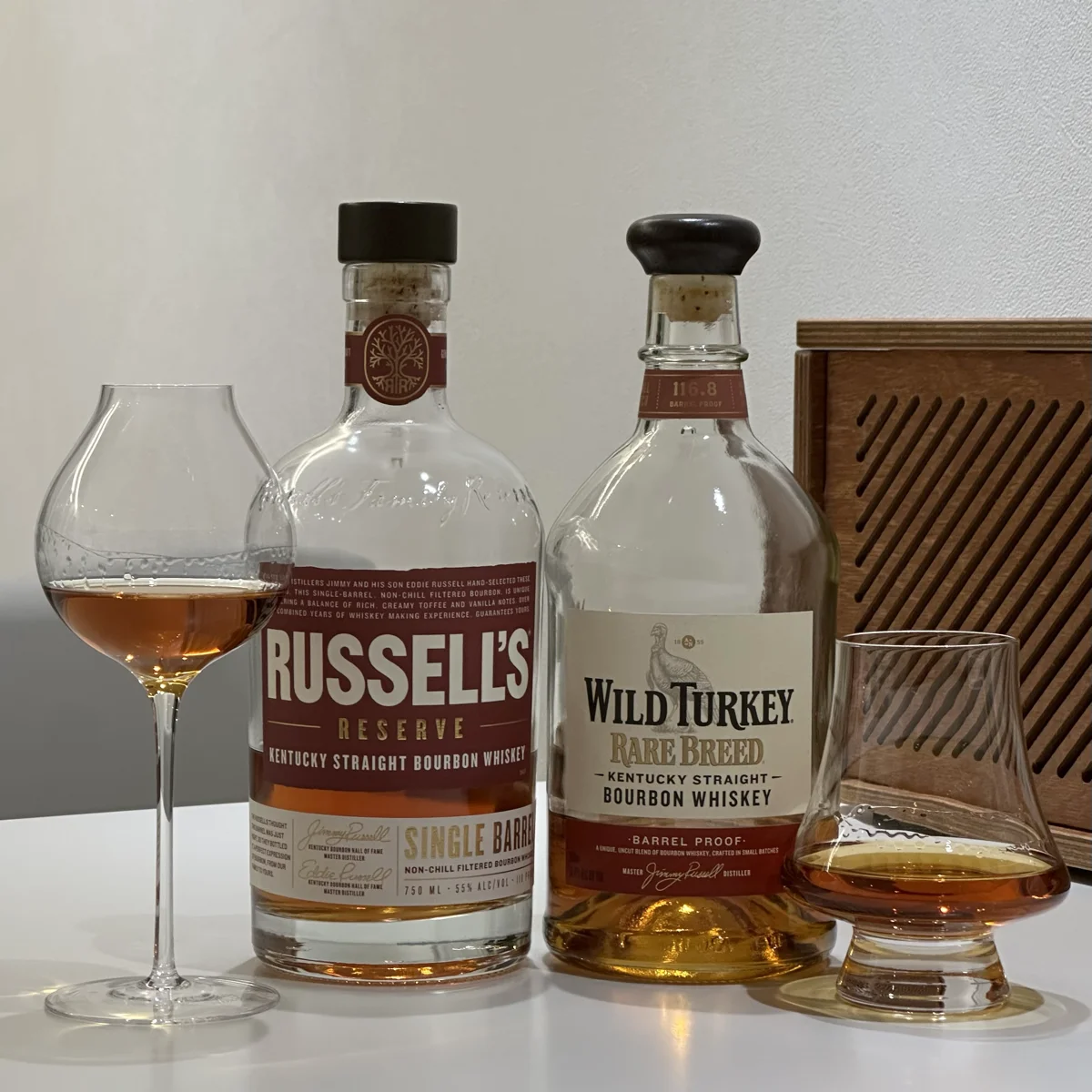
Why these two
The interesting bit is that the same Wild Turkey distillery is taking two routes to deliver “110+ proof, non-chill-filtered bourbon.”
- Russell’s Single Barrel: 110 proof, single barrel. Eddie Russell picks each barrel one at a time and bottles its individual taste. No age statement.
- Rare Breed: 116.8 proof, blend of 6/8/12-year stocks. Eddie sets the blend ratio each year to lock the overall taste.
Shared distillery conditions: 115 barrel entry proof (10 below the industry cap), charred white oak, non-chill-filtered. The split is between “let one barrel’s taste come through” and “blend ages into one finished picture.”
On price, I paid roughly 100K KRW for Russell’s and under 70K for Rare Breed. The 30K gap (about a third more for Russell’s) ended up nudging the call quite a bit.
Russell’s vs Rare Breed at a glance
| Aspect | Russell’s Single Barrel | Wild Turkey Rare Breed |
|---|---|---|
| ABV | 55% (110 proof) | 58.4% (116.8 proof) |
| Age | NAS, single barrel | 6/8/12-year blend |
| Nose | Malty, vanilla, nuts, broadly sweet | Dark chocolate, dark brown sugar, nuts |
| Palate | Tannin that builds the longer you hold it, softer sweetness and spice | Sweet up front, dense oak, herbal-spicy back, light tannin |
| Finish | Light acetone, baking spice | Dark chocolate carrying over, grain, warm close |
| Body | Full, tannin settles at the back | Heavy, the nose sweetness rides into the finish |
3.4 ABV points apart on paper. The two glasses read like the same family. The gap is in how dense everything is, about one step’s worth across the board.
Side by side - nose
Rare Breed first. Dark chocolate up front. You can smell the sweetness before you sip. Underneath, a dark brown sugar weight. Nuts sit on the base. The whole picture leans toward cacao and dark-sugar territory. For 116.8 proof, the alcohol lands behind the sweetness rather than ahead of it, which I didn’t quite expect.
Switch glasses to Russell’s. Similar shape - take the dark chocolate out, drop vanilla in its spot. Malt sits underneath, nuts stay in place. The broadly sweet impression carries over, but the center moves from cacao to vanilla. That single swap is the most legible difference between the two noses.
On nose alone, they read like the same family. One thing changes (dark chocolate to vanilla), everything else holds.
Side by side - palate
Rare Breed leads with direct sweetness. Oak spreads thick across the palate behind it. Herbal and spicy notes follow a beat later, and a light tannin from the oak shows up at the tail without pressing down hard. Sweet, then oak, then herb-spice, then a touch of tannin - the sip walks through them in order.
Russell’s plays the same sequence quieter. The tannin builds the longer you hold the sip rather than landing right away. Sweetness and spice are both softer than Rare Breed’s, about a step lower. Same family of notes, same order, lower volume. By the time you swallow, the tannin stays longer than the sweetness.
Side by side, the nose impression carries through. Same family, different intensity. Rare Breed lays every note down a touch denser.
Side by side - finish
The finish is where the two glasses pulled apart most clearly for me.
Rare Breed carries the dark chocolate from the nose straight into the finish. Grain warmth layers underneath, and the close is heat - a slow chest-warming sensation that runs long. With the nose sweetness still in play at the finish, the sip doesn’t really feel over.
Russell’s finish opens with a light acetone note. Baking spice threads behind it. There’s no dark, sweet residue carried over from the nose - the finish rewrites itself, and acetone takes the lead.
Going to the finish, the gap reads widest. Not a direction change. Rare Breed just carries its core note all the way through, while Russell’s lets the thread drop.
So which one
Both glasses sit in the same family, and Rare Breed runs a touch denser across nose, palate, and finish. The dark chocolate and brown sugar opening, the slightly louder sweetness and spice on the palate, the dark chocolate carrying into the finish - each note lands a step heavier than Russell’s same move. Russell’s follows the same shape, just dialed down. On the pour alone, I’d lean toward Rare Breed.
Adding the 30% price gap pushes the call further in the same direction. Rare Breed lives up to the value-pick reputation. Under 70K KRW for 116.8 proof, a 6/8/12-year blend, non-chill-filtered, with a dark chocolate thread running from nose to finish - the textbook bourbon shape, at the lower price. Russell’s has the single-barrel angle, but it doesn’t catch Rare Breed on either flavor or price in a head-to-head pour.
Flavor and price both land on Rare Breed for me. If I’m buying one bottle, I’d grab Rare Breed. The high-proof, non-chill-filtered Wild Turkey thing comes through fully here. Russell’s is the one to grab when you’re curious about how each barrel tastes a little different.
The three-glass loop I sketched in the Knob Creek 9 vs Russell’s writeup is now complete. All three sit around 50% or above, so none of them feel watered. Each takes the Kentucky bourbon idea in a different direction. For a longer-aged angle on the same distillery, Wild Turkey 12 is worth visiting, and for a different cask-strength direction, sherry CS like Aberlour A’bunadh shows what the same proof bracket does on the other side.
![[Sherry] GlenDronach Ode to the Dark vs Kavalan Solist](/assets/images/posts/2026-06-09-glendronach-ode-to-the-dark-vs-kavalan-solist-oloroso-sherry-comparison.webp)
![[Sherry] Tamdhu 12 vs 15 vs Batch Strength Side by Side](/assets/images/posts/2026-06-09-tamdhu-12-15-batch-strength-comparison-review.webp)
![[Sherry CS] GlenDronach Ode to the Dark Review](/assets/images/posts/2026-06-03-glendronach-ode-to-the-dark-review.webp)