 Spemer
A round black bottle landed on the camping table. Suntory Old Limited Design, brought back by a high school friend from a Japan trip and held onto for a few months. The deal was that we’d open it together outdoors, and that’s exactly where it ended up. With a whisky I haven’t tried before I always want the first pour neat, so I took mine in a paper cup as-is. A couple of friends went on the rocks, a couple went highball.
A bottle most people outside Japan never meet
Suntory Old is a Japanese blended whisky that launched in 1950. Inside the Suntory blended ladder it sits above Kakubin and below Special Reserve, Royal, and Hibiki. Outside Japan it doesn’t get the same airtime as Nikka Taketsuru or Hibiki - this one lives closer to the home dinner-table tier in Japan, which is probably why.
The nickname is “Daruma,” after the traditional Japanese roly-poly doll. Pick it up and you feel why - the rounded shoulders sit in the hand differently from a standard whisky bottle. The black glass with the gold label held up surprisingly well under the lantern.
The Limited Design line is an annual Japan-market label tied to the zodiac animal of the year. The one my friend brought back was the 2026 horse edition. The catch is that only the label and box are limited - the liquid inside is the same as the standard release. The label was really just an excuse for the occasion, and at a campsite that was excuse enough.
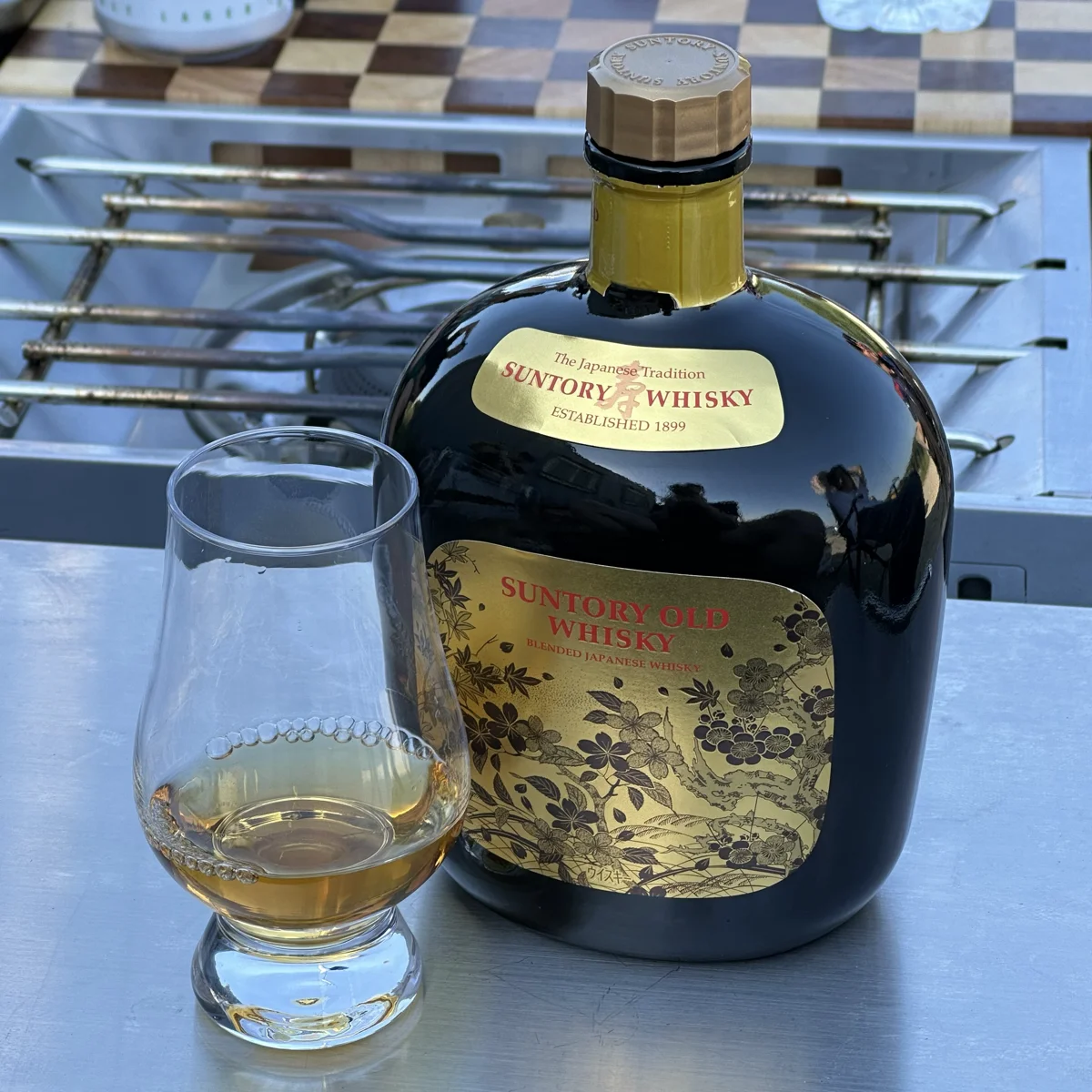
First pour at the campsite
43% ABV. Paper cup obviously isn’t going to give the nose a fair shake, and I knew it going in, but I wanted to drink it the way the night was already going. A whisky you can pour without thinking about glassware actually fits this bottle’s personality.
Nose
Properly sweet and floral. Even a quick pass under the nose pulls the sugar out first. Malt barely shows up. There’s something familiar about the shape, and after a beat I placed it - Royal Salute 21 reduced down a notch, more concentrated. Same floral lane, but Suntory’s version comes up tighter, more compact.
A trace of well-aerated Dewar’s 12 drifts through too. The difference is that Dewar’s leans caramel, while Suntory Old keeps the bright floral sweetness more in focus. The fact that the nose held together at all in a paper cup was the first thing that stood out.
Palate
Soft on entry. 43% but the alcohol barely registers as heat. That bright blended-whisky character spreads across the mouth, and inside it apple-leaning orchard fruit is the clearest note. Sweet vanilla follows a half-step behind.
The natural comparison is Salute 21 again. To me Suntory Old actually came out ahead. Salute can read a little hollow in places, but Old keeps the outline of the sweetness defined while staying soft. The swallow is silky, and the cup emptied faster than I planned.
The on-the-rocks pours pulled the apple note out a touch more, and the highballs lightened the sweetness into something that sat easily next to food. All three formats hold up fine.
Finish
A quiet sweetness stays in the mouth. A light oak closes in at the end, never aggressive, just enough to wrap the sweet tail cleanly. Not a long finish, not abrupt either. Enough to reset the palate before the next pour.
The Japanese whisky after Taketsuru
Honestly, my expectations for Japanese whisky had taken a hit. Nikka Taketsuru left me feeling the value didn’t land where the brand wanted it to, and I’d been keeping the Japanese blended shelf at arm’s length since. This bottle softened that impression.
The Limited Design thing doesn’t really matter. The juice is identical to the standard release, so the standard-label version drinks the same. What’s in the bottle is a clean, floral, drinkable blended whisky that earns its place at the lower end of the Suntory ladder, and it does so without trying too hard.
Would I keep one around on my own dime? Sure. Rating sits at 4.3.
Next Japanese blended on the list is Special Reserve. Curious how the next rung up in the same Suntory range plays differently.
![[Sherry] GlenDronach Ode to the Dark vs Kavalan Solist](/assets/images/posts/2026-06-09-glendronach-ode-to-the-dark-vs-kavalan-solist-oloroso-sherry-comparison.webp)
![[Sherry] Tamdhu 12 vs 15 vs Batch Strength Side by Side](/assets/images/posts/2026-06-09-tamdhu-12-15-batch-strength-comparison-review.webp)
![[Sherry CS] GlenDronach Ode to the Dark Review](/assets/images/posts/2026-06-03-glendronach-ode-to-the-dark-review.webp)